Runs a one-way ANOVA and prints a formatted group descriptives table followed by an ANOVA table. By default, runs the traditional ANOVA assuming equal variances. Optional parameters provide post-hoc tests, effect size, Levene's test, and confidence intervals. Set welch = TRUE for the Welch correction when equal variances cannot be assumed; its post-hoc test is Games-Howell. Handles haven-labelled, numeric, and factor grouping variables. For haven-labelled variables, numeric codes are displayed alongside labels in the group descriptives table.
Usage
jaov(
  formula,
  data,
  welch = FALSE,
  posthoc = NULL,
  effect.size = NULL,
  diagnostics = NULL,
  ci = NULL,
  subset = NULL,
  variable.id = NULL,
  value.id = NULL,
  case.processing.detail = NULL,
  full = FALSE,
  digits = NULL,
  print = NULL,
  ...
)
Arguments
- formula
A formula of the form
DV ~ Group. A transformed term such aslog(DV)is computed automatically: the tests and the descriptive output all use the transformed values.- data
A data frame containing variables referenced in
formula.- welch
Logical. If FALSE (default), runs traditional ANOVA. If TRUE, runs Welch's ANOVA (does not assume equal variances). Welch's F is not a ratio of two mean squares, so its table shows F, df1, df2 and p: Sum of Squares and Mean Square belong to the traditional ANOVA table and are not applicable to Welch's test. Welch's ANOVA needs at least 2 cases in every group, and some variation within every group: a group whose cases all hold one value has a variance of zero, which Welch's F divides by. The traditional ANOVA can include such a group, or a group of one case.
- posthoc
Logical or NULL. If TRUE, prints pairwise comparisons of the group means: Tukey HSD for the traditional ANOVA, and Games-Howell when welch = TRUE. Games-Howell does not assume equal variances: each comparison uses the two groups' own variances and its own degrees of freedom, shown in a df column, and the p-values and confidence intervals are adjusted for the number of groups through the studentized range distribution, as Tukey's are. Commercial statistical software offers the same test for unequal variances (Games-Howell in SPSS's ONEWAY post-hoc tests). A Games-Howell comparison with fewer than 2 degrees of freedom – possible when a group has two or three cases – shows its difference and its df and leaves its interval and p-value blank, with a line under the table saying so: the studentized range distribution is not defined there. With two groups no post-hoc table is printed or returned, after either ANOVA: the test above it is the only comparison. If NULL (default), defers to
joutput().- effect.size
Logical or NULL. If TRUE, prints eta-squared. If NULL (default), defers to
joutput().- diagnostics
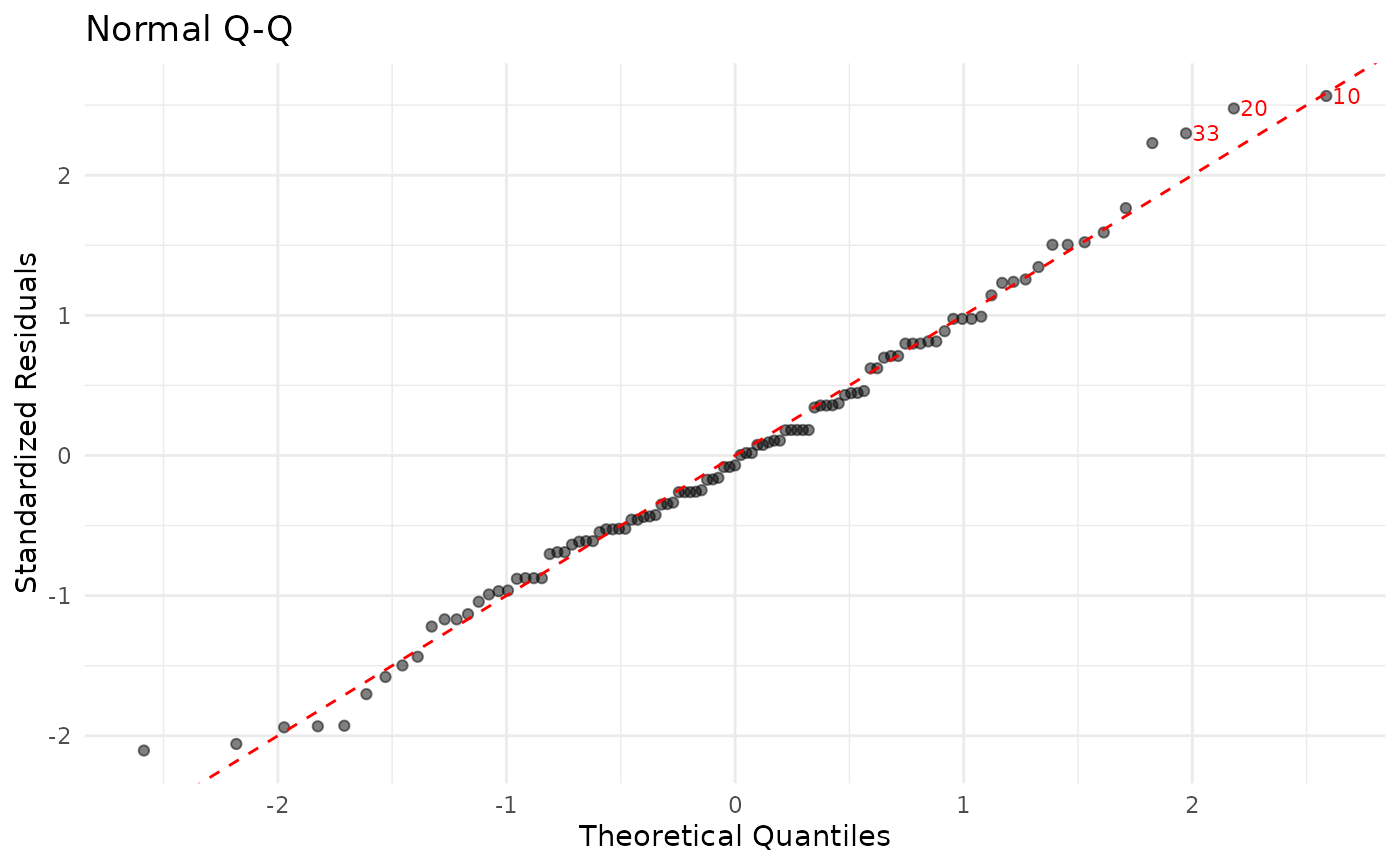
Logical, character vector, or NULL. If TRUE, prints Levene's test for homogeneity of variance, with a note under it when the test is significant (see "Unequal variances"), and draws a normal Q-Q plot of the standardized residuals – each case's distance from its group's mean – a look at normality as a plot rather than a test.
"levene"or"qq"asks for one of them;c("levene", "qq")for both. If NULL (default), defers tojoutput()'sdiagnosticssetting, which is off at every output level until it is set. The Q-Q plot is also drawn byjplot(result, which = "qq").- ci
Logical or NULL. If TRUE, adds 95% confidence intervals to the group descriptives table. If NULL (default), defers to
joutput().- subset
An optional unquoted logical expression (e.g.
Group == 1) to subset cases for this call only. Applied after jcomplete and jsubset. Does not affect other function calls. Written in R syntax and checked the wayjsubset()checks a filter:subset = NOT(Age < 40), for example, is refused with the correctedsubset = !(Age < 40)shown (seejsubsetfor a translation table).- variable.id
Character or NULL. Variable label display mode: one of
"both","names","labels","legend", or"legend.bottom"."names"shows variable names only;"both"shows"name: label";"labels"shows the DV and grouping-variable labels wherever the variable name appears (table captions and the ANOVA Source row; group levels follow the value.id mode) – best for short labels;"legend"/"legend.bottom"keep names and print a label legend after the output. NULL (default) defers tojoutput()'svariable.idsetting. Not a logical.- value.id
Character or NULL. Value-label display mode for the group descriptives rows:
"both"("code: label"),"values"(bare code), or"labels"(the label, degrading to the bare code where a code has none)."legend"and"legend.bottom"keep the bare code in the table and print a value-label legend after it ("legend"per-table,"legend.bottom"consolidated where multiple tables are produced). A no-op for grouping variables with no value labels. NULL (default) defers tojoutput()'svalue.idsetting. Not a logical.- case.processing.detail
Per-call override of the Case Processing Summary detail tier: one of
"none","totals", or"per_code".NULL(default) uses the activejoutput()level default. The Case Processing table itself prints only when a filter or listwise deletion excluded cases; otherwise a one-line N statement takes its place. See?joutput(case.processing).- full
Logical. If TRUE, turns on posthoc, effect.size and ci together. Does not override explicit FALSE values, and does not turn on diagnostics, which
diagnosticsalone governs.- digits
Integer or NULL. Number of decimal places for continuous statistics in the output tables (range 0-7;
digits = 0prints whole numbers with no trailing decimal point). Does not affect p-values, percentages, or integer quantities (counts, N, degrees of freedom), which keep their own fixed conventions. NULL (default) defers tojoutput()'sdigitssetting (default 3).Logical or NULL.
FALSEprints nothing – no table, no title, no note – and returns the result as every call does; errors and warnings still show.TRUEprints even underjoutput("silent").NULL(the default) prints unless the level is silent. For a script that keeps many results and wants no output: seejoutput.- ...
Reserved for argument-name checking. Passing
levene, the name of the diagnostics setting before version 0.9.219, produces an error that namesdiagnostics.
Value
Invisibly returns a list of class jst_anova containing:
model (the aov or oneway.test object),
model_frame (the analysis data frame used for plotting),
test_type, formula, descriptives, f,
df1, df2, p, eta_squared, n,
sample_info (pipeline and missing data counts), and
posthoc (the pairwise comparisons as an unrounded data frame,
with test naming the method; NULL when post-hoc tests
were not requested), and levene: Levene's test as printed, a
list of F, df1, df2, p and note –
the verdict of the note under a significant test
("acceptable", "unreliable" or "differ"), recorded
at every output level, or NA when no note applies (the test not
significant, or Welch's ANOVA run); NULL when Levene's test was
not asked for.
Details
A red title identifying the test type is printed first, followed by variable labels (if present), then the results tables.
A transformed outcome or grouping term in formula – log(x)
and the like – is computed once on the analysis data and used by the F
test, Levene's test, the post hoc comparisons, and the descriptives, so
they all describe the same values. The transforms supported inline, and
those that must be created as a column first, are as documented for
jlm.
A value or vector from your workspace may be named inside a computed
term, as in lm(): I(x > cutoff) with cutoff <- 10.
A data frame may not: write y ~ x with data = MyData,
not MyData$y ~ MyData$x.
A variable may not: jstats analyzes the variables of a data frame, so
a vector holding one value for each case – w in
I(x * w), or an object reached with $ such as
lst$w – is added to the data frame first
(MyData$w <- w), where lm() would read it from the
workspace; the stop gives that line. A vector of any other length used
value by value is refused, where lm() would repeat the shorter
one; a set used with %in% may have any length.
Unequal variances
The traditional ANOVA assumes the groups have the same variance, and
Levene's test (diagnostics = TRUE) asks whether they do. When it
is significant, a note under its table states the two things that
decide how much that matters – the ratio of the largest group's size to
the smallest, and of the largest standard deviation to the smallest –
and then takes one of three forms. Textbooks give different guidelines
and no single cutoff is agreed, so the note does not treat one as
exact:
Stevens (Applied Multivariate Statistics for the Social Sciences; Intermediate Statistics: A Modern Approach) treats the F test as robust to unequal variances while the largest group is less than 1.5 times the smallest.
Moore, McCabe and Craig (Introduction to the Practice of Statistics) treat the results as approximately correct while the largest standard deviation is less than twice the smallest; Howell (Statistical Methods for Psychology) gives the same limit as a variance ratio of four and adds that unequal variances and unequal group sizes do not mix.
The note reads "usually still acceptable" when the largest group is no
more than 1.25 times the smallest and the largest standard deviation no
more than twice the smallest; it says the p-value may not be reliable
when the group sizes differ by more than 1.5 times and the standard
deviations by more than twice; and between the two it says that
guidelines differ. The 1.25 is not a textbook figure. It comes from
simulations run for jstats (a true null hypothesis, normal scores, a
nominal 5 percent level, four groups, the smallest group the most
variable): in the cases tried, the traditional ANOVA rejected up to
about 7.5 percent of the time inside the first range, about 7 to 13
percent in the middle one, and 13 to 16 percent in the last. The
direction matters: those figures are for the worst case, and when the
LARGEST group is the most variable the rate is lower, falling under 5
percent where the sizes are clearly unequal. Welch's ANOVA
(welch = TRUE) does not assume equal variances. The note is not
printed at joutput("minimal"), which prints the table alone.
See also
jstats for the package overview,
workflow conventions, and complete function listing.
Examples
# With explicit data frame
jaov(WellbeingScore ~ Region, data = community)
#> One-Way ANOVA
#>
#> Analysis N: 103
#>
#> Group Descriptives: WellbeingScore by Region
#> Group N Mean SD 95% CI Lower 95% CI Upper
#> -------- -- ------ ------ ------------ ------------
#> 1: North 27 52.963 10.147 48.949 56.977
#> 2: South 20 48.150 14.741 41.251 55.049
#> 3: East 31 50.935 9.936 47.291 54.580
#> 4: West 25 50.800 11.923 45.878 55.722
#>
#> ANOVA: WellbeingScore by Region
#> Source df Sum of Squares Mean Square F p
#> -------- --- -------------- ----------- ----- ----
#> Region 3 266.441 88.814 0.667 .574
#> Residual 99 13179.384 133.125
#> Total 102 13445.825
#>
#> Eta-squared: 0.020
#>
jaov(WellbeingScore ~ Region, data = community, full = TRUE)
#> One-Way ANOVA
#>
#> Analysis N: 103
#>
#> Group Descriptives: WellbeingScore by Region
#> Group N Mean SD 95% CI Lower 95% CI Upper
#> -------- -- ------ ------ ------------ ------------
#> 1: North 27 52.963 10.147 48.949 56.977
#> 2: South 20 48.150 14.741 41.251 55.049
#> 3: East 31 50.935 9.936 47.291 54.580
#> 4: West 25 50.800 11.923 45.878 55.722
#>
#> ANOVA: WellbeingScore by Region
#> Source df Sum of Squares Mean Square F p
#> -------- --- -------------- ----------- ----- ----
#> Region 3 266.441 88.814 0.667 .574
#> Residual 99 13179.384 133.125
#> Total 102 13445.825
#>
#> Eta-squared: 0.020
#>
#> Tukey HSD Post-Hoc Comparisons
#> Comparison Mean Difference 95% CI Lower 95% CI Upper p (adjusted)
#> ----------- --------------- ------------ ------------ ------------
#> South-North -4.813 -13.708 4.082 .494
#> East-North -2.027 -9.964 5.910 .909
#> West-North -2.163 -10.532 6.206 .906
#> East-South 2.785 -5.862 11.433 .834
#> West-South 2.650 -6.395 11.695 .870
#> West-East -0.135 -8.240 7.969 1.000
#>
# The data frame may also be given positionally
jaov(WellbeingScore ~ Region, community)
#> One-Way ANOVA
#>
#> Analysis N: 103
#>
#> Group Descriptives: WellbeingScore by Region
#> Group N Mean SD 95% CI Lower 95% CI Upper
#> -------- -- ------ ------ ------------ ------------
#> 1: North 27 52.963 10.147 48.949 56.977
#> 2: South 20 48.150 14.741 41.251 55.049
#> 3: East 31 50.935 9.936 47.291 54.580
#> 4: West 25 50.800 11.923 45.878 55.722
#>
#> ANOVA: WellbeingScore by Region
#> Source df Sum of Squares Mean Square F p
#> -------- --- -------------- ----------- ----- ----
#> Region 3 266.441 88.814 0.667 .574
#> Residual 99 13179.384 133.125
#> Total 102 13445.825
#>
#> Eta-squared: 0.020
#>
# Checking the equal-variances assumption: Levene's test
jaov(WellbeingScore ~ Region, data = community, diagnostics = TRUE)
#> One-Way ANOVA
#>
#> Analysis N: 103
#>
#> Levene's Test for Homogeneity of Variance
#> F df1 df2 p
#> ----- --- --- ----
#> 1.751 3 99 .162
#>
#> Group Descriptives: WellbeingScore by Region
#> Group N Mean SD 95% CI Lower 95% CI Upper
#> -------- -- ------ ------ ------------ ------------
#> 1: North 27 52.963 10.147 48.949 56.977
#> 2: South 20 48.150 14.741 41.251 55.049
#> 3: East 31 50.935 9.936 47.291 54.580
#> 4: West 25 50.800 11.923 45.878 55.722
#>
#> ANOVA: WellbeingScore by Region
#> Source df Sum of Squares Mean Square F p
#> -------- --- -------------- ----------- ----- ----
#> Region 3 266.441 88.814 0.667 .574
#> Residual 99 13179.384 133.125
#> Total 102 13445.825
#>
#> Eta-squared: 0.020
#>
#> (Diagnostic plot produced: Normal Q-Q)
 #>
# Pairwise comparisons after the traditional ANOVA: Tukey HSD
jaov(WellbeingScore ~ Region, data = community, posthoc = TRUE)
#> One-Way ANOVA
#>
#> Analysis N: 103
#>
#> Group Descriptives: WellbeingScore by Region
#> Group N Mean SD 95% CI Lower 95% CI Upper
#> -------- -- ------ ------ ------------ ------------
#> 1: North 27 52.963 10.147 48.949 56.977
#> 2: South 20 48.150 14.741 41.251 55.049
#> 3: East 31 50.935 9.936 47.291 54.580
#> 4: West 25 50.800 11.923 45.878 55.722
#>
#> ANOVA: WellbeingScore by Region
#> Source df Sum of Squares Mean Square F p
#> -------- --- -------------- ----------- ----- ----
#> Region 3 266.441 88.814 0.667 .574
#> Residual 99 13179.384 133.125
#> Total 102 13445.825
#>
#> Eta-squared: 0.020
#>
#> Tukey HSD Post-Hoc Comparisons
#> Comparison Mean Difference 95% CI Lower 95% CI Upper p (adjusted)
#> ----------- --------------- ------------ ------------ ------------
#> South-North -4.813 -13.708 4.082 .494
#> East-North -2.027 -9.964 5.910 .909
#> West-North -2.163 -10.532 6.206 .906
#> East-South 2.785 -5.862 11.433 .834
#> West-South 2.650 -6.395 11.695 .870
#> West-East -0.135 -8.240 7.969 1.000
#>
# When equal variances cannot be assumed: Welch's ANOVA
jaov(WellbeingScore ~ Region, data = community, welch = TRUE)
#> Welch's One-Way ANOVA
#>
#> Analysis N: 103
#>
#> Group Descriptives: WellbeingScore by Region
#> Group N Mean SD 95% CI Lower 95% CI Upper
#> -------- -- ------ ------ ------------ ------------
#> 1: North 27 52.963 10.147 48.949 56.977
#> 2: South 20 48.150 14.741 41.251 55.049
#> 3: East 31 50.935 9.936 47.291 54.580
#> 4: West 25 50.800 11.923 45.878 55.722
#>
#> Welch's ANOVA: WellbeingScore by Region
#> F df1 df2 p
#> ----- --- ---- ----
#> 0.559 3 50.3 .645
#>
#> Note: Sum of Squares and Mean Square are not applicable to Welch's ANOVA.
#> For the standard ANOVA table, run jaov() without welch = TRUE.
#>
#> Eta-squared: 0.020
#> (Note: Eta-squared is calculated from the traditional SS decomposition.)
#>
# Pairwise comparisons after Welch's ANOVA: Games-Howell
jaov(WellbeingScore ~ Region, data = community, welch = TRUE,
posthoc = TRUE)
#> Welch's One-Way ANOVA
#>
#> Analysis N: 103
#>
#> Group Descriptives: WellbeingScore by Region
#> Group N Mean SD 95% CI Lower 95% CI Upper
#> -------- -- ------ ------ ------------ ------------
#> 1: North 27 52.963 10.147 48.949 56.977
#> 2: South 20 48.150 14.741 41.251 55.049
#> 3: East 31 50.935 9.936 47.291 54.580
#> 4: West 25 50.800 11.923 45.878 55.722
#>
#> Welch's ANOVA: WellbeingScore by Region
#> F df1 df2 p
#> ----- --- ---- ----
#> 0.559 3 50.3 .645
#>
#> Note: Sum of Squares and Mean Square are not applicable to Welch's ANOVA.
#> For the standard ANOVA table, run jaov() without welch = TRUE.
#>
#> Eta-squared: 0.020
#> (Note: Eta-squared is calculated from the traditional SS decomposition.)
#>
#> Games-Howell Post-Hoc Comparisons
#> Comparison Mean Difference 95% CI Lower 95% CI Upper df p (adjusted)
#> ----------- --------------- ------------ ------------ ---- ------------
#> South-North -4.813 -15.196 5.570 31.8 .597
#> East-North -2.027 -9.038 4.983 54.6 .869
#> West-North -2.163 -10.370 6.044 47.3 .896
#> East-South 2.785 -7.404 12.975 30.1 .879
#> West-South 2.650 -8.304 13.604 36.2 .914
#> West-East -0.135 -8.070 7.799 46.7 1.000
#>
# Using juse() default
juse(community)
#> Default data frame set to: community
jaov(WellbeingScore ~ Region)
#> One-Way ANOVA
#> Using default data frame: community
#>
#> Analysis N: 103
#>
#> Group Descriptives: WellbeingScore by Region
#> Group N Mean SD 95% CI Lower 95% CI Upper
#> -------- -- ------ ------ ------------ ------------
#> 1: North 27 52.963 10.147 48.949 56.977
#> 2: South 20 48.150 14.741 41.251 55.049
#> 3: East 31 50.935 9.936 47.291 54.580
#> 4: West 25 50.800 11.923 45.878 55.722
#>
#> ANOVA: WellbeingScore by Region
#> Source df Sum of Squares Mean Square F p
#> -------- --- -------------- ----------- ----- ----
#> Region 3 266.441 88.814 0.667 .574
#> Residual 99 13179.384 133.125
#> Total 102 13445.825
#>
#> Eta-squared: 0.020
#>
jaov(WellbeingScore ~ Region, full = TRUE)
#> One-Way ANOVA
#> Using default data frame: community
#>
#> Analysis N: 103
#>
#> Group Descriptives: WellbeingScore by Region
#> Group N Mean SD 95% CI Lower 95% CI Upper
#> -------- -- ------ ------ ------------ ------------
#> 1: North 27 52.963 10.147 48.949 56.977
#> 2: South 20 48.150 14.741 41.251 55.049
#> 3: East 31 50.935 9.936 47.291 54.580
#> 4: West 25 50.800 11.923 45.878 55.722
#>
#> ANOVA: WellbeingScore by Region
#> Source df Sum of Squares Mean Square F p
#> -------- --- -------------- ----------- ----- ----
#> Region 3 266.441 88.814 0.667 .574
#> Residual 99 13179.384 133.125
#> Total 102 13445.825
#>
#> Eta-squared: 0.020
#>
#> Tukey HSD Post-Hoc Comparisons
#> Comparison Mean Difference 95% CI Lower 95% CI Upper p (adjusted)
#> ----------- --------------- ------------ ------------ ------------
#> South-North -4.813 -13.708 4.082 .494
#> East-North -2.027 -9.964 5.910 .909
#> West-North -2.163 -10.532 6.206 .906
#> East-South 2.785 -5.862 11.433 .834
#> West-South 2.650 -6.395 11.695 .870
#> West-East -0.135 -8.240 7.969 1.000
#>